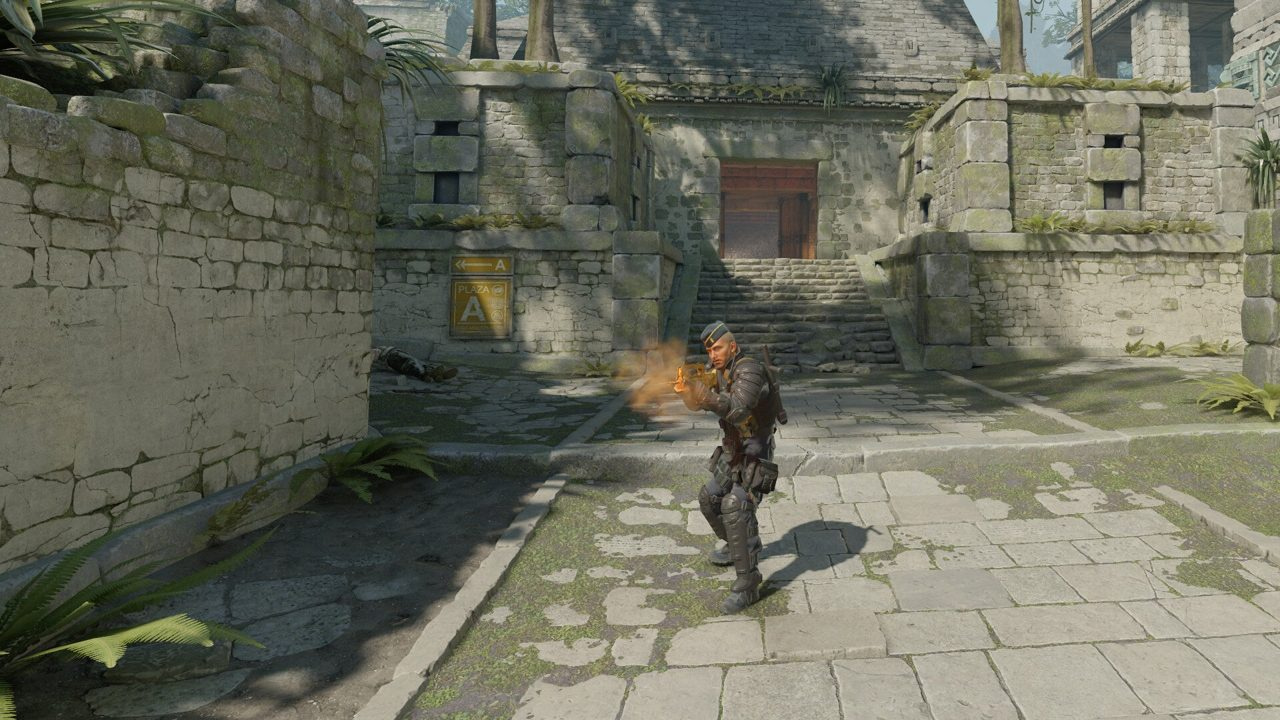
Counter-Strike 2 runs on Source 2, and grenade behavior is fundamentally different from CS:GO. Smokes bloom over seconds instead of popping instantly, HE damage follows new falloff curves, molotovs spread across surfaces, and subtick throw registration changes jump-throw timing. Muscle memory from old lineups fails silently until a ranked round costs you the site.
This guide is the utility pillar reference: how each grenade type behaves in CS2, how smoke timing compares to CS:GO, why flash blind depends on look angle, how bounce audio telegraphs throws, and how to budget utility in the economy. Pair mechanics with map-specific lineups in our Inferno smokes guide, Dust2 guide, and Mirage guide — mechanics explain why lineups work; map guides show where to throw.
After every Counter-Strike patch, re-test your highest-value smokes in a private server. Valve continues tuning smoke rendering and molotov spread — a lineup that worked last month may land short today.
Quick answer: CS2 grenade mechanics
- HE max ~57 HP unarmored at center; falloff steep — two HEs often needed for a kill.
- Smokes bloom 2–4 seconds; early gaps allow brief shots — do not assume instant cover.
- Flash blind scales with look angle and distance — back-turned players take minimal effect.
- Molotovs spread on contact surfaces; incendiaries behave similarly but cost more on CT.
- Jump-throw binds still essential for long lineups — bind via config guide.
- Bounce audio differs by surface and throw type — enemies hear underhand vs overhand.
- Utility damage and kills feed economy pressure — track nade damage on scoreboard.
- Re-test lineups after every patch; CS:GO coordinates rarely transfer 1:1.
Key takeaways
- Source 2 smokes are dynamic volumes — exploit bloom gaps before full coverage.
- HE damage tables matter for post-plant denial and eco-round punishes.
- Flash effectiveness depends on look angle — pop flashes beat straight overhand throws.
- Molotovs clear corners and force movement where smokes only block vision.
- Jump-throw binds remain mandatory for competitive lineups in CS2.
- Bounce sound telegraphs throw type — vary timing to mask executes.
- Utility economy: full buy needs 4–5 grenades per player on execute rounds.
- Patch awareness prevents silent lineup failures in Premier.
Table of contents
- Key takeaways
- Source 2 grenade physics — what changed from CS:GO
- HE grenade damage and falloff
- Smoke bloom, timing, and CS:GO comparison
- Flashbang blind angles and effectiveness
- Molotov spread and incendiary behavior
- Bounce audio and throw tells
- Jump-throw binds and throw types
- Economy of utility — when to buy and save
- Patch awareness and lineup re-testing
- Utility practice routine — weekly schedule
- Frequently asked questions
- Conclusion
Source 2 grenade physics — what changed from CS:GO
CS:GO grenades used the older Source engine with predictable instant-smoke deployment and fixed bounce coefficients. Source 2 in Counter-Strike 2 introduces volumetric smoke simulation, updated friction on grenade bounces, subtick throw registration, and molotov fire that spreads along surface geometry rather than painting a flat circle.
The practical impact: throws feel slightly different on the same coordinates, smokes take time to reach full coverage, and combined smokes merge into larger volumes instead of stacking as separate clouds. Players who only memorized CS:GO pixel lineups without understanding physics lose rounds when bloom timing or bounce angles shift after a patch.
| Mechanic | CS:GO behavior | CS2 Source 2 behavior |
|---|---|---|
| Smoke deploy | Near-instant full volume | Gradual bloom over 2–4 seconds |
| Smoke shape | Fixed cylinder/blob | Dynamic expanding volume; merges with other smokes |
| Throw registration | Tick-based | Subtick — smoother release timing |
| HE falloff | Known fixed curve | Similar concept, re-tuned values |
| Molotov spread | Circular burn zone | Surface-following spread pattern |
| Bounce physics | Source 1 friction | Updated friction; slightly different roll paths |
| Jump-throw | Bind-dependent timing | Still bind-dependent; subtick affects release frame |
HE grenade damage and falloff
HE grenades deal damage based on distance from detonation center, armor state, and whether the target is crouching behind cover. Maximum damage to an unarmored player at the epicenter is approximately 57 HP — rarely enough for a solo kill on a full-health enemy. Two well-placed HEs on a grouped eco stack or a post-plant defuser can secure the round.
HE damage also chips armor and contributes to economy pressure. Even 20–30 damage forces opponents to buy kits or heal inefficiently. Track your nade damage on the scoreboard — consistent 30+ per round means your throws are landing center mass, not bouncing off walls.
- Throw HE on stuck defuse spots — common on Dust2 B site and Mirage A default.
- Pair HE with molotov to block escape from fire zone.
- Eco rounds: stack two HEs on a predictable rush path — see anti-rush strategies.
- Pre-throw HE before peek to soften anchor HP — follow with flash entry from flashbang guide.
| Distance from center | Approx. damage (unarmored) | Approx. damage (armored) | Competitive use |
|---|---|---|---|
| 0–1 m (direct) | ~57 HP | ~40–45 HP | Stacked site execute, eco punish |
| 2–3 m | ~35–45 HP | ~25–35 HP | Post-plant denial on defuser |
| 4–5 m | ~20–30 HP | ~15–22 HP | Chip before entry; force kit use |
| 6–8 m | ~10–18 HP | ~8–14 HP | Minimal — reposition throw |
| 9 m+ | <10 HP | <8 HP | Wasted — save for better angle |
Smoke bloom, timing, and CS:GO comparison
CS2 smokes deploy from the impact point and expand outward over several seconds. During early bloom, gaps exist at the smoke edges and sometimes through the center — enemies can land shots through these windows. Full coverage arrives roughly 2–4 seconds after impact, depending on geometry and whether multiple smokes merge.
Combined smokes on the same area merge into a larger volume — useful for full site blocks on executes. Separate smokes on different angles create independent volumes that do not connect. This differs from CS:GO where smokes felt like instant, independent cylinders.
| Aspect | CS:GO | CS2 Source 2 | Ranked implication |
|---|---|---|---|
| Deploy speed | Instant (~0.5 s) | Gradual bloom (2–4 s) | Delay entries until smoke fills |
| One-way smokes | Rare, map-specific | More common during bloom phase | Exploit early; avoid being exploited |
| Smoke fading | Fixed timer fade | Volume dissipation over time | Late-round gaps appear gradually |
| Lineup transfer | High transfer rate | Partial — timing differs | Re-test every lineup in CS2 |
| Merged smokes | Stacked independent | Combined larger volume | Double-smoke chokes for executes |
| Shoot-through | Minimal | Possible during early bloom | Do not assume instant safety |
Map-specific smoke lineups that account for bloom timing live in our Inferno smokes guide. For Mirage window and connector smokes, cross-reference the Mirage guide execute sections.
Flashbang blind angles and effectiveness
Flash effectiveness in CS2 depends on three variables: distance from detonation, whether the target is looking at the flash, and line-of-sight exposure. A player facing away from a pop flash takes minimal blindness — sometimes only a brief white edge. A player staring directly at a center detonation can be fully blinded for 2–3 seconds at close range.
Pop flashes — throws that detonate just as you peek — exploit this angle math. The enemy sees the flash origin and gets full effect; you peek from an off-angle and avoid direct exposure. Straight overhand flashes over walls blind everyone in radius including teammates who forget to turn.
| Look angle | Distance | Blind duration (approx.) | Tactical note |
|---|---|---|---|
| Direct view of flash | 0–3 m | 2.0–3.0 s full white | Entry flash — swing immediately at pop |
| Direct view | 5–8 m | 1.0–2.0 s | Standard execute flash |
| Direct view | 10 m+ | 0.5–1.0 s partial | Fakes only — not entry worthy |
| 90° off-angle | Any | 0.3–0.8 s partial | Minimal — do not rely for entry |
| Back turned | Any | Near zero | Why pop flash timing matters |
| Through smoke | 3–5 m | 1.0–2.5 s | Forces AWPs off angle behind smoke |
Molotov spread and incendiary behavior
Molotovs and incendiaries ignite on first surface contact and spread fire along the ground geometry — up slopes, around corners, and across flat surfaces. The burn zone expands over roughly one second after impact, then persists for several seconds depending on surface type. Fire damage ticks continuously while standing in the zone.
Molotovs (T-side) and incendiaries (CT-side) function similarly but differ in price and inventory slot. CT incendiaries cost more but arrive faster in buy menu for defensive defaults. Molotovs are essential for clearing corners smokes cannot — a smoke blocks vision but a CT can still hold the angle; a molly forces movement.
- Pair molly with smoke on executes — smoke blocks vision, molly clears default/pit.
- Post-plant: molly on defuse kit spot while smoking off retake path.
- CT anti-rush: incendiary on choke before HE — see anti-rush strategies.
- Inferno banana: molly car after smoke — detailed in Inferno smokes guide.
| Grenade | Side | Cost (approx.) | Primary use | Smoke alternative? |
|---|---|---|---|---|
| Molotov | T | $400 | Site clear, post-plant deny | No — forces movement |
| Incendiary | CT | $600 | Delay push, choke deny | No — area denial |
| Smoke | Both | $300 | Vision block | No — does not force movement |
| HE | Both | $300 | Chip damage | No — burst only |
Bounce audio and throw tells
Grenades produce distinct bounce sounds based on surface material — metal, stone, wood, and dirt each have recognizable audio signatures. Underhand right-click throws produce softer initial release sounds compared to overhand left-click lobs. Enemies with good audio settings and HRTF enabled can identify throw type and approximate origin from bounce count and surface sound.
Competitive teams vary throw timing to mask execute audio — throwing smokes on different cadences prevents CTs from counting nades and predicting the hit site. A predictable three-smoke execute rhythm telegraphs the site every round.
| Throw type | Audio signature | Enemy info gained | Countermeasure |
|---|---|---|---|
| Overhand lob | Loud initial release, high arc bounces | Throw origin direction | Vary timing; throw from off-angle |
| Underhand toss | Quieter release, low arc | Close-range throw location | Use for pop flashes and close smokes |
| Jump-throw | Footstep + jump + release | Long lineup detected | Fake jump; throw from different spot |
| Metal bounce | Sharp ping | Specific map zone (e.g., Nuke vent) | Use to fake presence elsewhere |
| Multiple bounces | Rhythmic bounce count | Lineup type identification | One-bounce throws when possible |
Jump-throw binds and throw types
Long-range smoke lineups in CS2 still require jump-throw binds — a console bind that releases the grenade at the apex of a jump for maximum distance. CS2 subtick registration makes the release frame slightly more consistent than CS:GO tick-based throws, but the bind remains mandatory for competitive lineups on Dust2, Mirage, Inferno, and other Active Duty maps.
Three throw modes matter: left-click overhand (maximum distance, highest arc), right-click underhand (minimum distance, low arc), and left+right click mid-throw (medium distance). Jump-throw combines with left-click for long lineups. Configure binds in an autoexec — step-by-step in our config and binds guide.
- Bind jump-throw: alias that +jump's, -attack's, and -jump's in one command sequence.
- Test each lineup 5 times in empty server after any patch or config change.
- Left-click + jump-throw for long smokes (Dust2 cross, Mirage window).
- Right-click underhand for close pop flashes and short smokes.
- Mid-throw (both clicks) for medium-range lineups without jump.
- Never change throw bind mid-season — muscle memory is bind-specific.
Economy of utility — when to buy and save
Full utility on T-side execute rounds typically costs $1,200–$1,500 per player: smoke ($300), flash ($200), HE ($300), molotov ($400). CT defensive utility runs $800–$1,200 with incendiary ($600) replacing molotov. Teams that buy rifles but skip utility lose execute rounds to AWPs holding angles that a $200 flash would have cleared.
Eco and force rounds have different utility math. On eco, one flash ($200) or HE ($300) can swing a round — a full buy without utility on force is often worse than a half-buy with two flashes. Track whether your team buys utility before rifles on force rounds — this is a common ranked leak.
| Round type | Minimum utility | Recommended loadout | Common mistake |
|---|---|---|---|
| Full buy execute | 1 smoke + 1 flash | 2 smoke, 2 flash, 1 HE, 1 molly | Rifle only, zero utility |
| Default / map control | 1 smoke or 1 flash | 1 smoke, 1 flash, 1 HE | Saving all nades for execute that never comes |
| Force round | 1 flash minimum | 1 flash + 1 HE or smoke | Force rifle with no utility |
| Eco / half buy | 1 flash or HE | 1 flash ($200) — highest ROI | Saving $0 utility then dying without impact |
| CT full buy | 1 incendiary | 1 smoke, 1 incendiary, 1 flash, 1 HE | Incendiary saved and dies with it |
| Post-plant | Save 1 smoke + 1 molly | Smoke retake path, molly defuse spot | Using all utility on entry, none for post-plant |
Patch awareness and lineup re-testing
Valve ships CS2 patches that regularly adjust smoke rendering, molotov spread radius, HE damage tuning, and grenade bounce physics. A lineup verified three months ago may fail silently after a patch — the smoke lands short, the molly does not reach the corner, the HE no longer chips enough for a follow-up kill.
After every patch listed on counter-strike.net/news, run a 10-minute private server check: throw your five highest-value smokes on your main map, one molly lineup, and one jump-throw smoke. If any miss, search for updated coordinates before queuing ranked.
- Patch day: read grenade-related notes first — smoke, molotov, HE, flash sections.
- Re-test: Inferno banana, Mirage window, Dust2 cross, one post-plant smoke.
- Community servers propagate updated lineups within days — verify in private match.
- Do not queue Premier on patch day until key lineups are confirmed.
- Cross-reference map guides for updated execute utility after major patches.
Utility practice routine — weekly schedule
Mechanics knowledge without reps is theory. Ten focused minutes daily beats one hour weekly. Rotate maps each session so lineups stay sharp across your Active Duty pool.
- Mon — Empty server: 5 Inferno smokes from Inferno smokes guide; focus on bloom timing.
- Tue — Empty server: 5 Mirage smokes (window, connector, stairs); test jump-throw bind.
- Wed — Deathmatch: one pop flash entry per life using flashbang guide timing.
- Thu — Empty server: 5 Dust2 smokes (cross, long, B door); verify post-patch.
- Fri — Competitive or Premier: track nade damage — target 30+ per full-buy round.
- Sat — Anti-rush drill: HE + incendiary on choke in casual — apply anti-rush strategies.
- Sun — Review one demo: note utility wasted vs utility that swung the round.
| Session | Duration | Focus | Success metric |
|---|---|---|---|
| Smoke lineups | 10 min | 5 throws × 2 maps | 8/10 land within bloom tolerance |
| Flash timing | 5 min | Pop flash + peek on 3 angles | Blind enemy before your peek |
| HE placement | 5 min | Post-plant and choke HEs | 30+ damage in competitive |
| Jump-throw verify | 5 min | Long smokes after patch | Consistent landing 5/5 |
| Economy audit | 2 min | Review last 5 demos utility spend | Zero full buys with no nades |
Frequently asked questions
Do CS:GO smoke lineups still work in CS2?
Many coordinates transfer but bloom timing and bounce paths differ. A smoke that worked in CS:GO may land in the right area but bloom too slowly for your execute timing. Re-test every lineup in a CS2 private server — never assume 1:1 transfer.
How long do CS2 smokes take to fully bloom?
Approximately 2–4 seconds from impact to full volume coverage. During early bloom, gaps exist that allow shots through. Wait for full bloom before committing entries, or flash through to force enemies off angle.
How much HE damage does a direct hit deal in CS2?
Maximum center detonation deals roughly 57 HP to unarmored targets and approximately 40–45 HP to armored. Two HEs are usually required to kill a full-health enemy — use HE for chip damage, post-plant denial, and eco punishes rather than solo kill attempts.
Do I still need a jump-throw bind in CS2?
Yes. Long-range smoke lineups on Dust2, Mirage, Inferno, and other Active Duty maps require jump-throw binds for consistent maximum-distance throws. Configure via alias in your autoexec — see our config and binds guide.
Why do my flashes not blind enemies on entry?
Flash effectiveness depends on look angle and distance. Enemies facing away from your throw take minimal blindness. Use pop flashes that detonate as you peek so enemies are looking toward the flash origin. See the flashbang guide for team flash protocols.
Should CTs buy incendiary or smoke on force rounds?
Incendiary on the main choke (banana, long, mid) delays rushes and pairs with HE for anti-rush setups. One incendiary plus one HE on a force round often outperforms a rifle-only force. See anti-rush strategies for choke-specific defaults.
How often should I re-test grenade lineups?
After every CS2 patch that mentions smoke, molotov, HE, or grenade physics — check counter-strike.net/news. At minimum, re-test your five main smokes monthly even without patches, as community lineup refinements improve accuracy.
Conclusion
CS2 grenade mechanics reward players who understand Source 2 physics, not just memorized coordinates. Smokes bloom over seconds, HE damage follows steep falloff, flash blind depends on look angle, and molotovs force movement where smokes only block vision. Bind jump-throw, budget utility in the economy, and re-test lineups after every patch.
Next reads: Inferno smokes for lineup depth, flashbang guide for entry timing, and config binds for jump-throw setup.