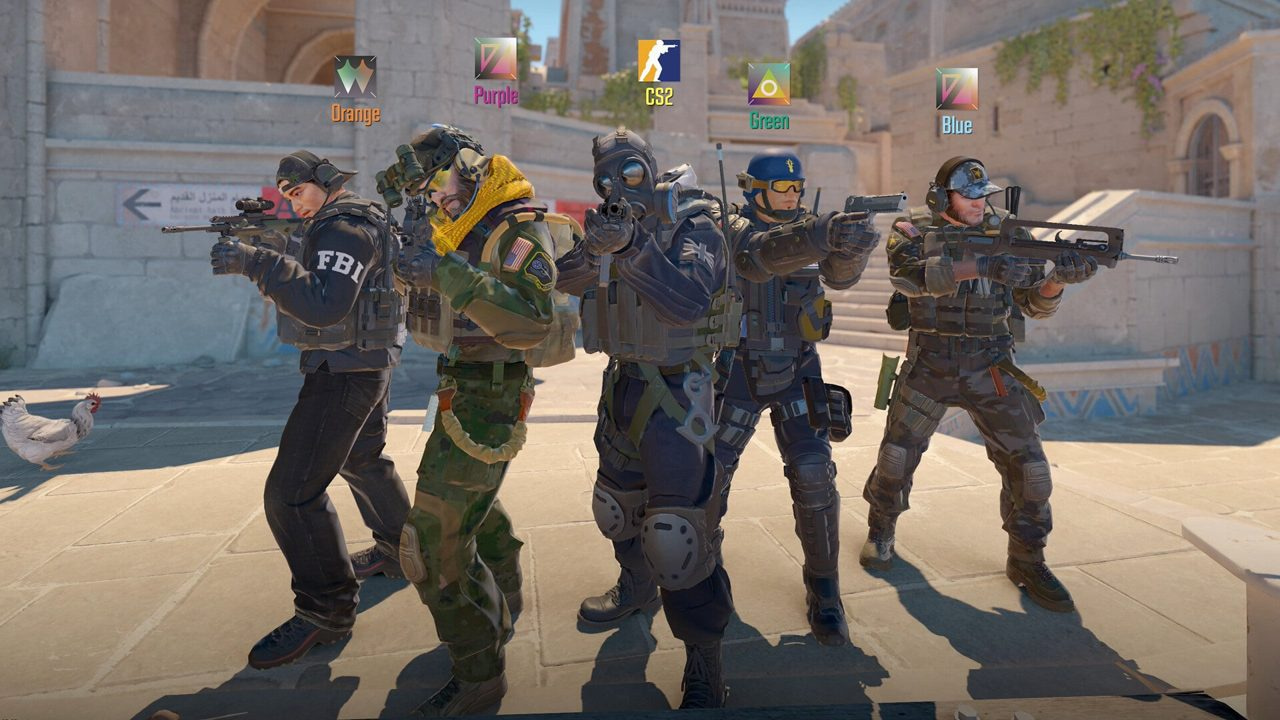
Your first ten Competitive matches will feel unfair. Someone holds an angle you did not know existed, you swing wide while moving, and your team buys rifles while you have $800. That is not a skill gap yet—it is missing structure.
Counter-Strike 2 is a round-based game where one death can cost your team the next two rounds. This guide is the path most players wish they had before queueing: how rounds work, how money works, one map to learn first, and mechanics that actually show up in Silver through Gold lobbies.
Quick answer: before you queue ranked
- Finish in-game training, then pick one map—Dust2 or Mirage—and play only that for your first 50 Competitive games.
- Set mouse sensitivity low enough that a full mousepad swipe turns you roughly 180°. Disable Windows mouse acceleration.
- Learn buy/save rules: never force-buy alone after two losses unless your team agrees on a call.
- Practice counter-strafing and tapping the AK/M4 before you worry about spray transfers.
- Learn five callouts on your map (long, cat, mid, tunnels, B site) and use a mic or ping system.
- Activate Prime Status before serious ranked—see our Steam & Prime setup guide.
Key takeaways
- Winning trades and managing economy beats a flashy K/D in the first 100 hours.
- One map at 80% knowledge beats five maps at 30%—depth first, breadth later.
- Your crosshair should live at head height on angles before you shoot, not after.
- One smoke and one flash per site on your main map will win more rounds than a new skin ever will.
- Lock your settings for 30 days; constant tweaks reset muscle memory.
Table of contents
- Key takeaways
- How a CS2 match actually works
- How CS2 differs from Valorant, Apex, and COD
- Core mechanics every new player must learn
- Economy: stop force-buying every round
- Pick one starter map and learn it properly
- Callouts: five words that save rounds
- Settings that will not fight your aim
- Your first-week training routine
- When to play Competitive vs Premier
- Common beginner mistakes
- Frequently asked questions
- Conclusion
How a CS2 match actually works
Every Competitive match is 30 rounds—first side to 13 wins. You play up to 12 rounds on Terrorist side, then swap to Counter-Terrorist (or the reverse). Ts plant the bomb; CTs stop the plant or defuse. No respawns mid-round.
That structure changes everything. Dying on round 4 is not just one kill—it is $300 to the enemy, lost utility, and often a forced eco next round. Good players play for the round win, not the highlight reel.
| Side | Your job | You lose the round when... |
|---|---|---|
| Terrorist | Plant the bomb or eliminate all CTs | Time runs out, bomb never plants, or your team is wiped |
| Counter-Terrorist | Stop the plant or defuse | Bomb explodes, time runs out after plant, or your team is wiped |
How CS2 differs from Valorant, Apex, and COD
Arena shooters reward constant movement and fast TTK duels. CS2 rewards when you move. Wide-swinging into a held angle without a flash is how you donate rifles to the enemy team.
The Source 2 update made smokes volumetric and hits more consistent with clean counter-strafing. Sloppy movement gets punished immediately—especially on subtick servers where your first shot accuracy depends on being fully stopped.
Core mechanics every new player must learn
Skip the 40-minute YouTube montage. Drill these four until they are automatic:
- Counter-strafing: tap D, release D, tap A briefly to stop, then shoot. If your bullets spray everywhere, you are still moving.
- Crosshair placement: walk common paths with your crosshair at head height on where an enemy would be—not at the floor.
- Recoil: pull down slightly for the first 7 AK bullets. Do not spray at long range; tap or burst.
- Economy: buy with your team. A lone rifle on an eco round is useless when four teammates have pistols.
Economy: stop force-buying every round
Economy is the silent reason teams lose games they should win. After a lost round you get a loss bonus; after a win you get more money. Full buy is roughly $4,700+ for rifles, armor, and utility—if four players cannot afford that, save together.
The classic mistake: you top-frag two rounds, force-buy an AK, die first contact, and your team is broke for three rounds. For full buy thresholds and force/eco calls, read our economy guide. Pistol rounds have their own rules—see the pistol round guide.
| Round | What happened | Smart team call | Why |
|---|---|---|---|
| 1 | Pistol round | Buy armor + utility OR full utility rush | Round 1 sets economy tempo |
| 2 | Lost pistol | Eco (save) or force if team agrees | Solo force breaks round 3 buys |
| 3 | Lost eco, $1,400 each | Full save to $4,700+ | One rifle vs five rifles loses |
| 4 | Won save, ~$3,200 | Force or half-buy with team | First real rifle round opportunity |
| 5+ | Trading rounds | Buy together, save together | Mixed buys lose to coordinated full buys |
Pick one starter map and learn it properly
The Active Duty pool rotates, but Dust2 and Mirage stay in most ranked queues. Pick one and run it for 50 matches before adding a second. Ancient is worth a third slot once you are comfortable—see our map pool update for what is live in 2026.
| Map | Why start here | First callouts to learn | Deep guide |
|---|---|---|---|
| Dust2 | Simple geometry, teaches long-range duels and mid control | Long, cat, mid, tunnels, B | Dust2 guide |
| Mirage | Layered utility, connector play, more team defaults | A ramp, window, connector, jungle, B apps | Mirage guide |
| Inferno | Close-range fights, banana control | Banana, pit, apps, A site, B site | Inferno smokes |
Callouts: five words that save rounds
You do not need 40 callouts on day one. You need five that your team understands instantly:
Say location, then number. "Two B" beats "they're there." For team comms habits in ranked, see our communication guide.
- "One long" — one enemy spotted long A (Dust2) or similar long sightline.
- "Cat" / "Short" — catwalk pressure toward A site.
- "Mid" — top mid or mid control fight happening.
- "Tunnels" / "Apps" — B pressure path (map-dependent).
- "Rotate" / "Save" — bomb spotted elsewhere, or round is lost—do not die for nothing.
Settings that will not fight your aim
Disable motion blur. Cap FPS slightly above your monitor refresh or leave uncapped if stable. Use headphones—not speakers—for footstep direction.
Most players land between 1.5–3.0 in-game sens at 800 DPI. The exact number matters less than keeping it unchanged for a month. Full breakdown in our competitive settings guide and crosshair guide.
Your first-week training routine
- Days 1–2: 10 min aim map (head-level flicks only) + 20 min deathmatch. Focus on stopping before you shoot.
- Days 3–4: Offline with bots—learn one smoke and one flash for each bombsite on your main map. Our grenade mechanics guide explains why timing beats memorizing 30 lineups.
- Day 5: Watch one pro demo on your map (HLTV or YouTube)—note where they look before they see anyone.
- Days 6–7: Queue unrated or low-pressure Competitive with comms on. Read our first ranked match guide before your first game.
When to play Competitive vs Premier
Start with Competitive matchmaking until you understand economy and one map. Premier adds map veto and visible CS Rating—great once you can contribute on both sides, punishing if you are still learning callouts.
Prime Status filters cheaters and smurfs partially—not perfectly. Activate it before grinding ranked. Details in our Premier mode guide and ranking system explainer.
Common beginner mistakes
| What you do | What actually happens | Fix |
|---|---|---|
| Push alone for a pick | You die, team plays 4v5 with no trade | Pair with a teammate or use a flash first |
| 6400 DPI, wrist-only flicks | Inconsistent spray, overshooting heads | Lower sens; use arm + wrist together |
| Force-buy after every loss | Team stuck on SMGs round 6–8 | Call save; buy as five or eco as five |
| Change settings every day | Zero muscle memory | Lock config 30 days minimum |
| Learn five maps at once | No site smokes, no defaults | One map to 50 games, then add one |
Frequently asked questions
Should I play Premier or Competitive first?
Competitive first. Learn economy, one map, and basic utility before Premier's map veto and rating pressure. Move to Premier once you can call buys and hold your own on both CT and T—usually after 30–50 Competitive games.
What sensitivity should I use?
Most ranked players sit between 1.5–3.0 at 800 DPI. Pick a number, play two weeks, then adjust once if needed. Consistency beats copying a pro's config.
How long until I rank up?
Expect 40–80 focused hours before rank reflects improvement—often longer if you map-hop constantly. Rank is a lagging indicator; death review and one main map speed things up.
Is CS2 harder than CS:GO?
Similar skill ceiling, different habits. Subtick movement and volumetric smokes changed timing. New players should learn CS2-native smokes and counter-strafing, not old CS:GO muscle memory.
Do I need Prime Status?
For serious ranked, yes. Prime matchmaking reduces bot lobbies and some smurf accounts. Follow our Steam & Prime setup guide before grinding.
One map or many maps to start?
One. Dust2 or Mirage for 50 games minimum. You need site smokes, common angles, and rotate timings memorized—not a surface-level tour of seven maps.
Conclusion
Your first 50 matches are about structure, not highlight reels. Learn how rounds and money work, pick one map, drill counter-strafing, and buy with your team. The rest—rank, spray control, advanced lineups—builds on that foundation.
Next steps: Dust2 guide or Mirage guide depending on your pick, then competitive settings once your aim feels consistent. When you are ready for Premier, read the Premier mode guide.