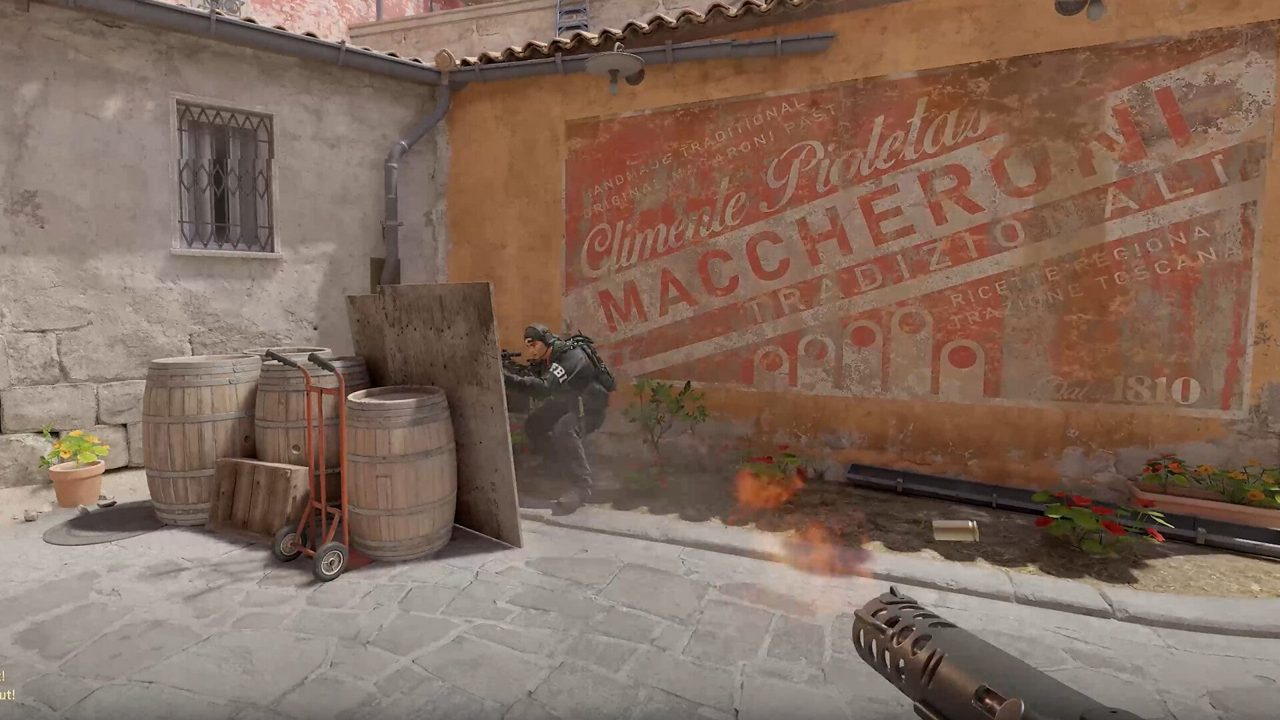
Train is the kind of map where one player holding ivy can stall an entire half—and where Ts who rush inner without utility walk into three crossfires. The layout splits cleanly between long-range fights outside and brutal close-quarters work around the sites.
When Train sits in the Active Duty pool, Premier veto habits change overnight. Teams that already know pop dog timings and A main smokes pick it with confidence; everyone else bans it and hopes the rotation ends soon.
This guide walks through Train callouts, how to fight for ivy and inner, full A and B executes, CT defaults, and the mistakes that cost ranked rounds. Check the current map pool before you commit veto prep—Train rotates in and out of Active Duty per Valve's Counter-Strike updates.
Quick answer: Train essentials
- Core callouts: ivy, pop dog, inner, ladder, A main, A site, B upper, B lower, CT.
- Take ivy with flash support before committing inner or a site hit.
- A execute needs A main smoke plus default or heaven coverage—never dry peek main.
- B hits flow through upper with a player cutting rotate via inner or ladder.
- CT default: one ivy AWPer for info, inner flex, B upper anchor with ladder backup.
- Post-plant A from inner; post-plant B from upper and ladder angles.
Key takeaways
- Ivy control opens both sites—losing it early forces predictable inner paths.
- Pop dog is the lurk lane; timing contact there catches rotating CTs off guard.
- Inner is choke-heavy—dry entries die before they trade.
- B upper wins post-plant; ladder is the retake path CTs use first.
- Train rewards structured executes over five-man rushes through main.
- Pair this guide with Mirage, Ancient, and Overpass for a full Active Duty toolkit.
Table of contents
- Key takeaways
- Train callouts you actually need
- Ivy and pop dog: winning the outside lane
- Inner control and mid-round pivots
- A main executes
- B upper and B lower takes
- CT-side defaults and crossfires
- Common ranked mistakes on Train
- Utility priorities for practice
- Frequently asked questions
- Conclusion
Train callouts you actually need
Train callouts are simpler than they look once you map the three lanes: ivy outside, inner connector, and the A/B site complexes. Mixing up pop dog and inner is the fastest way to lose a retake—call the right name every time.
- Ivy — long outside lane toward A; primary AWPer duel zone.
- Pop dog — the path from ivy toward inner; lurk and cut-rotate lane.
- Inner — central connector linking ivy, A, and B; highest-traffic choke.
- Ladder — vertical path between B upper and lower; critical for retakes.
- A main / A site — main entry and bombsite; default and heaven common CT spots.
- B upper / B lower — two-level B site; upper controls post-plant.
- CT spawn — rotation hub; CTs crossing here are vulnerable to pop dog timing.
Ivy and pop dog: winning the outside lane
Most Train rounds start with a quiet fight for ivy. Ts who win ivy force CTs to play reactive—inner becomes easier to take, and A main pressure becomes credible even before utility flies.
Take ivy with at least one flash and a second player ready to trade. The AWPer holding long angles has the advantage; your job is to close distance or burn utility until the angle becomes uncomfortable.
Pop dog is where lurks live. One player can sit pop dog while four prepare an A execute—when CTs rotate through inner toward A, pop dog contact catches them mid-transition. The timing rule: pop dog pushes when A main smokes land, not ten seconds before.
If ivy is lost early, do not force inner alone. Regroup, smoke off the AWPer angle, and hit B upper while CTs over-rotate toward A main noise.
Inner control and mid-round pivots
Inner is the spine of Train. Control it and both sites open; lose it and you funnel through one choke with CT crossfires waiting.
Standard T default: one ivy, one pop dog, two inner presence, one flexible. Inner players hold space and call CT aggression—when CTs dump utility into inner, execute the opposite site.
| Situation | T-side read | CT response |
|---|---|---|
| Heavy inner presence, no A main util | Fake inner, hit B upper | Keep one B anchor, delay inner push |
| A main smoke + inner flash | Full A execute incoming | Stack A, call rotate from ivy |
| Pop dog contact late round | Lurk cutting rotate | Check pop dog before leaving site |
| Ivy control lost, inner quiet | B hit or A split via ladder | AWPer holds angle, do not peek |
A main executes
A site on Train is tight. A main is the primary entry, and CTs who hold main with an AWPer or rifle crossfire can stall executes for free if Ts skip utility.
Minimum A execute utility: A main smoke (blocks CT spawn vision), default or heaven smoke, and two flashes for main entry. Molly default if CTs play aggressive site holds.
Entry order matters. First player flashes main; second swings wide and trades. Third and fourth flood through inner simultaneously—if inner is still contested, the execute fails before plant.
Post-plant A: hold from inner, not main. Main is a one-way exit for Ts after plant; CT retakes come through inner and ladder. One player inner, one site, one pop dog covers rotate.
- Smoke A main and default from safe ivy or inner positions.
- Flash main twice—CT heaven and default both need clearing.
- Entry swings main while inner player trades CT rotate.
- Plant default or safe; immediately shift to inner post-plant.
B upper and B lower takes
B site is vertical. B upper is where Ts want to be after plant— it overlooks the site and punishes CT retakes from lower. B lower is the CT anchor position and the first retake path.
Standard B hit: smoke B upper choke or cut CT vision from inner, molly lower default, flash upper entry. One player lurks inner or ladder to catch rotates; three take site.
The ladder is the swing factor. If CTs control ladder during your B hit, post-plant becomes a nightmare. Either molly ladder on execute or have pop dog player hold ladder timing before contact.
CT B setup: one upper anchor with HE and molly, one lower or site flex. Do not double-push upper without inner info—Ts love picking aggressive CTs when inner is lost.
| B execute type | Utility needed | Win condition |
|---|---|---|
| Upper rush | Upper smoke + lower molly + flash | Fast plant before CT rotate |
| Upper default with inner cut | Inner smoke + upper flash | Block rotate, trade upper |
| Lower clear into upper | Two flashes + molly lower | Methodical take, slower plant |
| Fake B, rotate A | Sound B upper, smoke A main | CT over-rotate to B, hit A |
CT-side defaults and crossfires
Standard 2-1-2 works on Train: ivy AWPer, inner flex, A helper, B upper anchor, B lower/site. Adjust when you read full A or B stack from utility— but do not abandon ivy entirely; Ts will take it for free.
Save utility for execute denial. One smoke and one molly on B upper choke late round beats wasting both at 1:40 when Ts are still defaulting.
| Position | Role | Priority call |
|---|---|---|
| Ivy AWPer | Long info, delay T advance | Numbers outside, AWPer spotted |
| Inner flex | Rotate hub, early contact call | Execute direction before contact |
| A main/support | Delay main push, trade heaven | Main smoke landing |
| B upper anchor | Hold upper, molly choke | Lower contact, ladder sound |
| B lower/site | Anchor default, retake ladder | Plant location after contact |
Common ranked mistakes on Train
- Ts pushing A main without smokes—CT AWPer or rifle crossfire ends the round.
- Ignoring ivy and rushing inner dry—three CT angles wait in the choke.
- Pop dog lurk calling too early and revealing the hit before smokes land.
- CTs over-peeking ivy for picks—one death opens the entire map for Ts.
- Post-planting A from main instead of inner—CT retake trades are free.
- B executes without ladder control—CTs retake upper while Ts hold lower.
- Banning Train in Premier without ever practicing it—see Premier guide for veto logic.
Utility priorities for practice
Learn five lineups: A main smoke from ivy, default smoke from inner, B upper smoke, pop dog flash timing, and ladder molly. Run them in an empty server before ranked—late smokes mean entry dies before inner can trade. Re-test lineups after Counter-Strike 2 patches on Steam, since Source 2 smoke behavior can shift between updates.
Frequently asked questions
Is Train in the Active Duty map pool?
Train rotates in and out of Active Duty. Check the current map pool and in-game Premier veto before you prep strats.
What is the most important area on Train?
Ivy. Winning ivy gives Ts credible A main and pop dog pressure; losing it forces predictable inner paths CTs can stack against.
Should I AWPer on Train?
Ivy is the classic AWPer spot for CTs. Ts can AWPer ivy too, but rifle + utility often wins the outside fight more reliably in ranked.
How do I retake A site on Train?
Push inner with flash support, clear heaven and default, and expect a post-plant player holding inner angle. Coordinate ladder player if Ts play split post-plant.
Best T-side default on Train?
Spread ivy, pop dog, and inner presence. Take map control for 30–40 seconds, read CT utility, then execute the site they did not stack.
Conclusion
Train punishes teams that treat it like a smaller Dust2. Ivy and pop dog control the pace; inner decides whether executes live or die; B upper wins rounds after plant.
Learn the callouts, drill five smokes, and run ten casual games before taking Train into Premier veto. For pool context and veto strategy, read the 2026 map pool guide and pair with the ranking system overview so your map prep matches your ranked goals.